Seeing flashing lights and a line of stopped cars ahead on a South Carolina road can trigger immediate anxiety, even if you have done nothing wrong. DUI checkpoints are designed to feel serious, and for drivers who are unsure of their rights, that feeling can lead to mistakes that make a difficult situation worse.
At Joe Good Law, we help South Carolina drivers navigate DUI stops, charges, and everything that follows. Whether you are preparing for the possibility of encountering a checkpoint or you have already been through one and are now trying to understand what happened, this guide gives you the clear, practical information you need. If you have questions about a specific situation, our DUI defense team is ready to help.
Are DUI Checkpoints Legal in South Carolina?
Yes. DUI checkpoints, also called sobriety checkpoints or roadblocks, are legal in South Carolina. The United States Supreme Court addressed the constitutionality of checkpoints in Michigan Dept. of State Police v. Sitz in 1990, holding that properly conducted sobriety checkpoints do not violate the Fourth Amendment's protections against unreasonable searches and seizures. South Carolina courts have followed that framework.
However, the fact that checkpoints are legal does not mean every checkpoint is automatically lawful. South Carolina law and constitutional standards require that checkpoints be conducted according to specific rules, and a checkpoint that does not meet those requirements may still be challenged.
What Makes a Checkpoint Lawful Under South Carolina Rules
For a DUI checkpoint to be legally valid in South Carolina, it must meet several requirements. The decision to establish the checkpoint must be made by supervisory law enforcement personnel, not individual officers acting on their own discretion. The location must be chosen based on legitimate public safety criteria. Drivers must be stopped according to a neutral, predetermined pattern rather than based on an officer's individual suspicion. The checkpoint must be reasonably visible with adequate warning to approaching drivers. And law enforcement is generally required to provide advance public notice of the checkpoint's general location.
If any of these requirements were not met at the checkpoint where you were stopped, that is a fact worth discussing with a DUI defense attorney. A checkpoint that fails to satisfy constitutional and statutory requirements may result in evidence being suppressed.
What Usually Happens During a DUI Checkpoint Stop
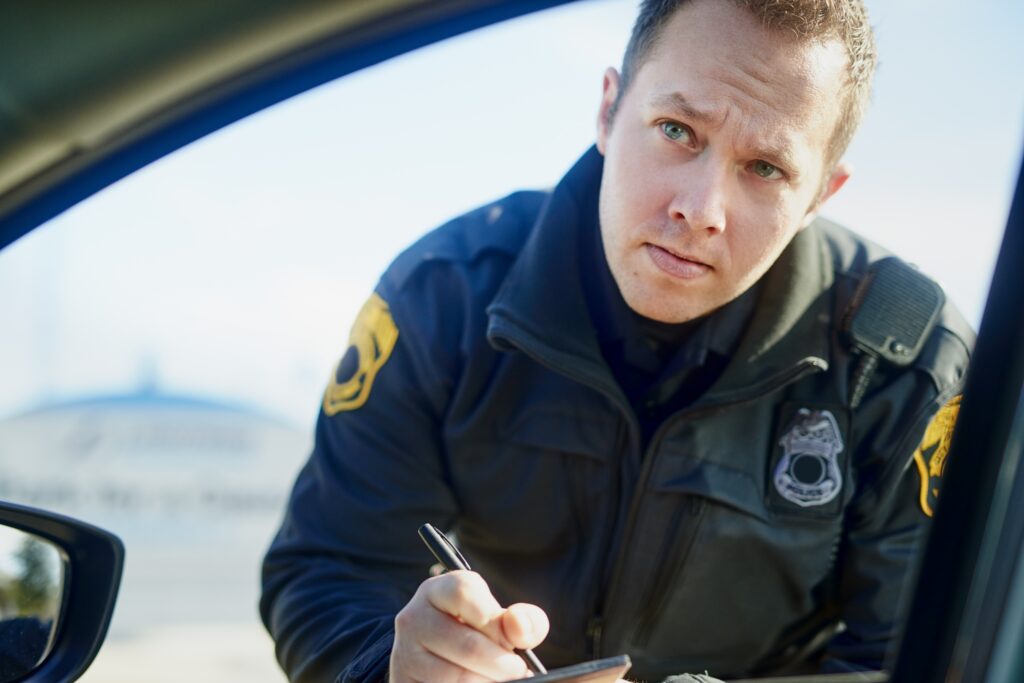
When you approach a checkpoint, you will be directed to stop by officers who are typically in uniform with marked vehicles and visible lighting. The initial contact is brief. An officer will approach your window, ask for your license and registration, and observe you during the interaction. They are looking for obvious signs of impairment: the smell of alcohol, slurred speech, glassy or bloodshot eyes, slow responses, or visible open containers.
If the officer sees nothing concerning during that initial contact, you will typically be waved through within a minute or two. If they observe something that raises suspicion, they may direct you to a secondary screening area where additional questioning or testing can occur. The checkpoint itself does not authorize a lengthy detention without some individualized basis for suspicion. The initial stop is brief by design.
What You Must Do and What You Do Not Have To Do
Understanding the difference between what the law requires of you and what officers may request is one of the most practically useful things you can take away from this post.
License, Registration, and Basic Questions at the Stop
You are required to provide your driver's license, vehicle registration, and proof of insurance when asked. South Carolina law requires drivers to carry these documents and present them to law enforcement upon request. Refusing to provide them creates an immediate legal problem that has nothing to do with DUI.
This is also why checkpoints often result in citations that have nothing to do with alcohol — expired registration, missing proof of insurance, or equipment violations. If you drove away from a checkpoint with one of those, it's worth knowing those tickets can be fought before you pay the fine and accept the consequences.
Beyond that, your obligations narrow considerably. You are not required to answer questions about where you have been, where you are going, whether you have been drinking, or how much you had to drink. You have the right to remain silent beyond the basic identification exchange. You can politely decline to answer questions by saying something simple: "I prefer not to answer questions without an attorney." You do not need to be rude or confrontational. You simply do not have to provide information that could be used against you.
Can You Refuse Field Sobriety Tests in South Carolina?
Yes. Field sobriety tests, which typically include the horizontal gaze nystagmus test, the walk-and-turn test, and the one-leg stand test, are not mandatory in South Carolina. You have the right to decline them. These tests are voluntary, and the results are used by officers to build probable cause for an arrest. Declining them does not automatically result in an arrest, though an officer may use other observations to make that determination.
It is worth understanding that field sobriety tests are subjective. Performance can be affected by nervousness, physical conditions, footwear, uneven pavement, and many other factors that have nothing to do with alcohol consumption. If you declined a field sobriety test at a checkpoint and were subsequently arrested anyway, that is a relevant fact in your defense. You can read more about how checkpoint stops can escalate in our earlier post on DUI checkpoints in South Carolina.
What Happens If You Refuse a Breath Test?
This is where the law gets significantly more complicated, and where many drivers make decisions they later regret.
How Implied Consent Can Affect Your License
South Carolina operates under an implied consent law. By driving on South Carolina roads, you have legally consented in advance to submit to a breath, blood, or urine test if a law enforcement officer has probable cause to believe you are driving under the influence. This is not the same as a field sobriety test. Implied consent applies to the chemical test administered after a lawful arrest, not the preliminary roadside screening.
If you refuse a breath test after being arrested for DUI in South Carolina, the consequences are serious and separate from the criminal charge itself. A first refusal results in a six-month license suspension. A second refusal within ten years carries a nine-month suspension. These suspensions are administrative, meaning they happen through the DMV process independently of what happens in criminal court, and they can be difficult to undo.
Refusing the test also does not guarantee a better outcome in the criminal case. Prosecutors can argue that refusal reflects consciousness of guilt, and juries are permitted to draw negative inferences. The decision to refuse or comply with a chemical test is one where having a DUI defense attorney involved as early as possible makes a meaningful difference.
Common Mistakes Drivers Make at DUI Checkpoints
Most of the errors drivers make at checkpoints come from panic, not bad intentions. The most common ones include:
- Volunteering information about drinking before being asked anything
- Answering questions about where they have been and what they have consumed without realizing they do not have to
- Performing field sobriety tests under the assumption that compliance will prevent an arrest
- Arguing with or becoming confrontational toward officers at the scene
- Attempting to turn around before reaching the checkpoint in a way that draws immediate attention and gives officers a reason to follow
- Assuming that because the checkpoint felt routine, nothing that happened there can be challenged later
Staying calm, providing your documents, and keeping your responses minimal is the approach that protects you most effectively in the moment.
When a DUI Checkpoint Stop Turns Into an Arrest
If an officer develops individualized suspicion during your checkpoint stop, either through their observations or through a field sobriety test you chose to participate in, they may direct you to pull over for further investigation or place you under arrest. At that point, the checkpoint is no longer the primary legal issue. What matters is what happens from the moment of arrest forward.
You have the right to remain silent beyond basic identification. You have the right to an attorney. You should invoke both clearly and calmly. Do not attempt to talk your way out of the situation at the scene. Statements made after an arrest are frequently used against defendants, and the moment to start building your defense is not on the side of the road but in a conversation with a lawyer.
If your checkpoint stop resulted in a DUI arrest, our post on what happens after a first DUI in Mount Pleasant or Charleston walks through the process that follows.
When To Call a South Carolina DUI Defense Lawyer
You should contact a DUI defense attorney as soon as possible after a checkpoint arrest, and honestly, before the situation reaches that point if you can manage it. The earlier an attorney is involved, the more options exist, including:
- Challenging whether the checkpoint itself met South Carolina's legal requirements
- Questioning the basis for directing you to secondary screening
- Contesting the administration or scoring of any field sobriety tests
- Addressing implied consent issues and fighting an administrative license suspension
- Evaluating whether probable cause for the arrest was actually established
If you were stopped at a checkpoint in the Charleston area, Mount Pleasant, or anywhere across South Carolina, the Charleston DUI defense team at Joe Good Law is ready to review what happened and give you a straight answer about your options. There is no obligation, and the sooner you call, the more we can do. Contact us today to schedule your free consultation.